
Report
AlphaFold3, ESM3 and a Nobel Prize for computation
In eighteen months, structure prediction moved from proteins alone to whole biomolecular complexes — and won chemistry's highest honor.
Dr. Helena Cruz FACS
Chair, ACS Specialist Group on Computational Biology
November 2024 · 7 min read
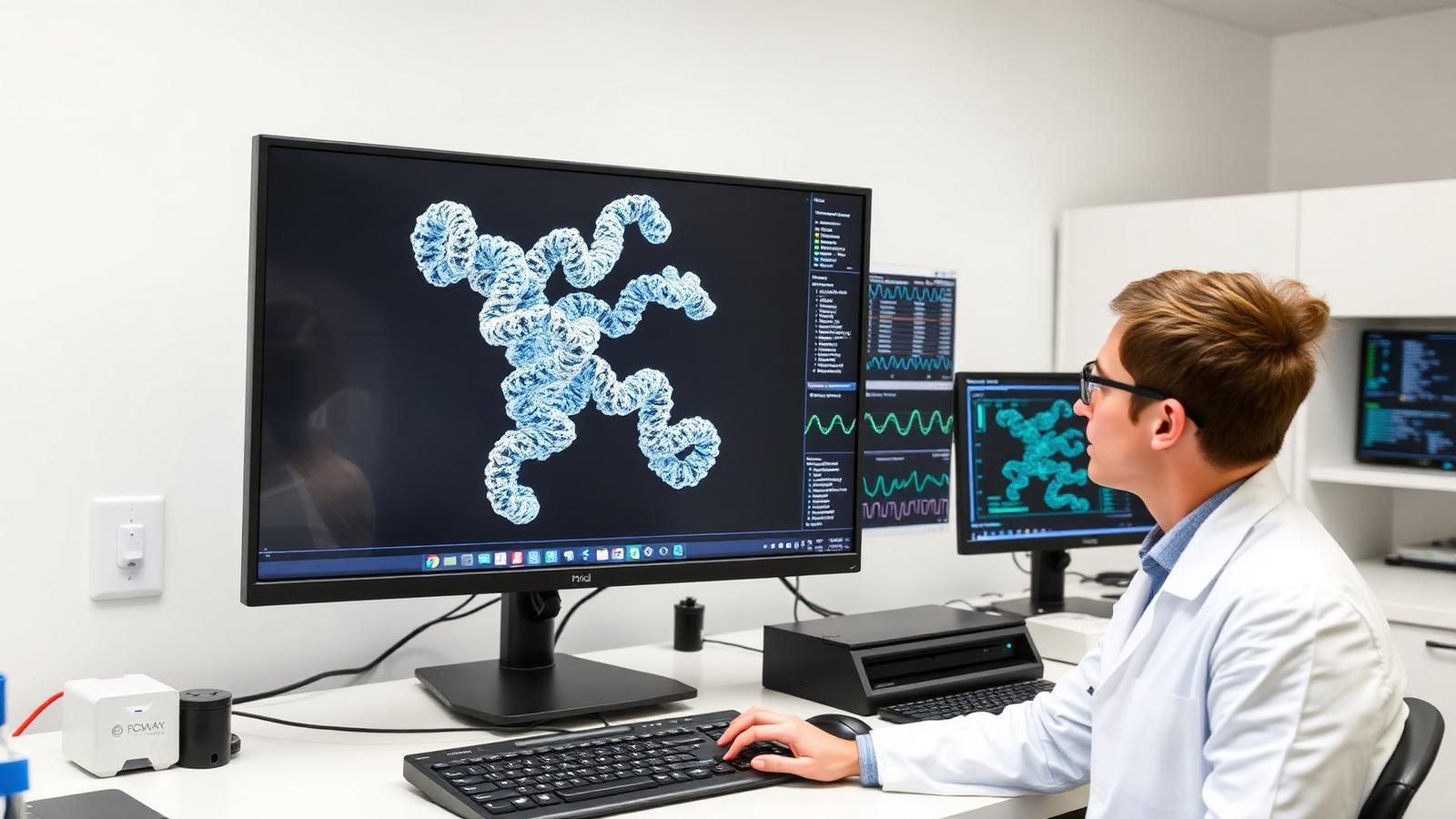
The 2024 Nobel Prize in Chemistry was, in substance, a prize for software. It is worth being precise about which software, and what it does and does not do.
From folding to interaction
On 8 May 2024, Google DeepMind and Isomorphic Labs published AlphaFold3 in Nature — 'Accurate structure prediction of biomolecular interactions with AlphaFold3', volume 630, pages 493 to 500. Where AlphaFold2 predicted the folded structure of a protein chain, AlphaFold3 uses a diffusion-based architecture to predict the joint structure of complexes: proteins with DNA, RNA, small-molecule ligands, ions and modified residues.
That extension is the difference between knowing the shape of a lock and modelling the lock with a key in it. Most therapeutic questions are interaction questions, which is why the release drew immediate attention from drug discovery groups.
The release also drew criticism over access. Code and weights were made available for academic, non-commercial use, with commercial access routed through Isomorphic Labs, and a free AlphaFold Server was published for non-commercial complex prediction. A correction addressing discrepancies in the supplementary pseudocode was published in Nature in January 2025.
“A prize in chemistry went to work whose primary artefacts are an architecture, a training regime and an open database.”
ESM3 and generative biology
On 25 June 2024, EvolutionaryScale — founded by researchers from Meta's FAIR protein team — launched ESM3, a generative model that reasons jointly over sequence, structure and function. The team used it to design esmGFP, a novel fluorescent protein the company characterised as equivalent to simulating roughly 500 million years of evolutionary distance from known fluorescent proteins. The same day, EvolutionaryScale announced a $142 million seed round led by Nat Friedman and Daniel Gross with Lux Capital, including participation from the venture arms of Amazon and NVIDIA. ESM3 was subsequently published in Science in January 2025.
The prize, and what it recognised
On 9 October 2024 the Royal Swedish Academy of Sciences awarded the Nobel Prize in Chemistry with one half to David Baker of the University of Washington for computational protein design, and the other half jointly to Demis Hassabis and John Jumper of Google DeepMind for protein structure prediction. The citation for Hassabis and Jumper rests on AlphaFold2 and its validation at CASP14; Baker's recognises decades of work in the Rosetta lineage.
For the computing profession the lesson is institutional. A prize in chemistry went to work whose primary artefacts are a neural network architecture, a training regime and an open database. Members should note that the recognised contribution included making predictions available at scale, not merely making them accurately.
Join the professional body behind this work
ACS members receive our research first, free CPD and ethics modules every year, and a route to professional registration assessed by their peers.
Become a memberMore from ACS Insights
Optimus: a humanoid robot from prototype to production line
Four years from an AI Day slide to a converted Fremont assembly line — and still no commercial sale.
AnalysisGrok, Colossus and the compute arms race
xAI built a 100,000-GPU cluster in 122 days, doubled it, and merged twice. The externalities arrived with the electricity.
ArticleA national consortium to build trust in AI
ACS joins federal partners, universities and industry to strengthen assurance practice for high-impact AI systems.